
Christmas in July! Save up to 20% on EVERYTHING
It’s time for our annual Christmas in July sale! Save up to 20% on all books and Christmas cards through the end of the month. Browse our book selection using the tabs above, keeping in mind that these sale prices are better than our usual bulk discounts. If you’d planned to place a bulk order in the future, now is the time!
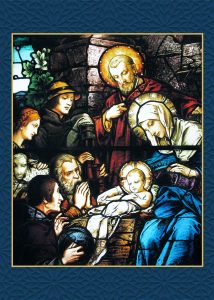
The card pictured at right, “God Most High,” depicts the holy family in stunning stained glass, gathered together with shepherds in adoration of the Christ child. The inside text is Stanza 3 of Martin Luther’s Christmas hymn, “From Heaven Above to Earth I Come”:
This is the Christ, our God Most High,
Who hears your sad and bitter cry;
He will Himself your Savior be
From all your sins to set you free.
Luther wrote the text of this hymn in 1534 as a sort of pageant or Christmas devotion for his own family. In fact, this particular stanza is addressed to the shepherds as part of “an extended paraphrase of the words of the angel from Luke 2:11–12. Luther goes beyond a simple retelling of the story to emphasize the great joy that comes from knowing that Jesus came ‘from all your sins to set you free,’” as Pr. W.H. Otto observes in a Lutheran Witness article from 2009. His entire article is worth reading to understand the hymn’s structure and how its writing was influenced by the 14th-century medieval folk tradition of the garland song.
Now Available: The Great Works of God: Leviticus + An endorsement from Dr. Geoff Boyle
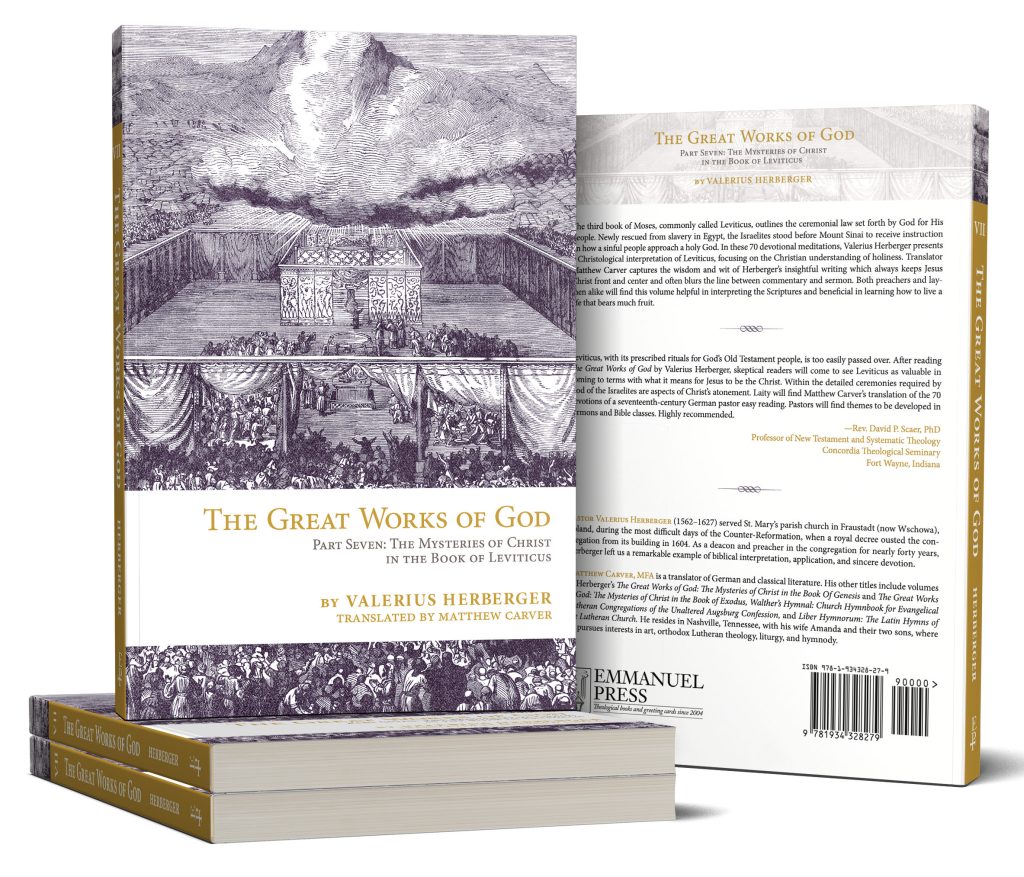 We are delighted to announce the release of The Great Works of God, Part Seven: The Mysteries of Christ in the Book of Leviticus, written by Valerius Herberger, translated by Matthew Carver. Find a description of the book, purchasing information, endorsements, and excerpts here.
In addition, we offer you the following review from Rev. Dr. Geoffrey Boyle, Professor of Pastoral Ministry and Missions at Concordia Theological Seminary, Fort Wayne, Indiana:
“Consolation in the name of Jesus—that’s what Valerius Herberger delivers in Part Seven of his meditations on Scripture. Much like Augustine’s Confessions, this devotional commentary teaches and exhorts, convicts and comforts the Christian through a running prayer to the Father, through the Son, with the Holy Spirit. Every page richly orders all of Leviticus towards Jesus Christ and His atoning sacrifice for us. Yet, as Herberger sees Jesus in the covenant to Adam and Eve, Abraham, Isaac, and Jacob, he’s never willing to leave us as the baptized out either. It’s always looking back and forward, and always from the cross of Christ.
“The breadth of Scriptural knowledge and citation, along with hymns and classical poems, makes this series of meditations through Leviticus a true nourishment of the soul, and Matthew Carver’s translation allows one to feed without interruption! That is, the book that causes most of us to stumble while reading through the Scriptures—Leviticus—comes to us, through Herberger’s insight and Carver’s translation, as a book of Christ. Herberger shows how profitably and clearly Leviticus ‘explains how the Lamb of God was slain from the beginning of the world (Rev. 13:8). From the beginning of the world, His bloody death was always seen in the sacrifices of the people of God; and from the beginning of the world, the power of His merit has also availed for all believing hearts’ (25). Everything points to Jesus: the sacrifice of cattle to His strength; the corners of the altar to the corners of His cross; the sheep to His gentleness and innocence; the goats and kids to His authority and boldness; the doves to His humility; and every burnt offering to Christ the crucified (31, 33). On and on it goes: Here in Leviticus the shadow, there in Christ the truth itself—’This is all full of mystery’ (72). With Herberger as your guide, the ‘Mosaic shell’ of Leviticus cracks and gives forth ‘the precious, delectable nut’ of the Gospel of Jesus Christ (79). And not just Leviticus alone, Herberger claims, but ‘how utterly the whole course of [Christ’s] life is wrapped up in the Old Testament!’ (165). So, ‘Rouse yourself, devout heart, and ponder this. You will discover it in truth’ (123).”
Dr. David Scaer endorses The Great Works of God: Leviticus
 “Leviticus, with its prescribed rituals for God’s Old Testament people, is too easily passed over. After reading The Great Works of God by Valerius Herberger, skeptic readers will come to see Leviticus as valuable in coming to terms with what it means for Jesus to be the Christ. Within the detailed ceremonies required by God of the Israelites are aspects of Christ’s atonement. Laity will find Matthew Carver’s translation of the 70 devotions of a 17th-century German pastor easy reading. Pastors will find themes to be developed in sermons and Bible classes. Highly recommended.”
Dr. David P. Scaer
Professor of New Testament and Systematic Theological
Concordia Theological Seminary
Fort Wayne, Indiana
Now available for pre-order: The Great Works of God: Leviticus
 Originally written in German by 17th-century Lutheran pastor Valerius Herberger, The Great Works of God, Part Seven: The Mysteries of Christ in the Book of Leviticus, is now available in English. The third book of Moses, commonly called Leviticus, outlines the ceremonial law set forth by God for His people. Newly rescued from slavery in Egypt, the Israelites stood before Mount Sinai to receive instruction on how a sinful people approach a holy God. In these 70 devotional meditations, Valerius Herberger presents a Christological interpretation of Leviticus, focusing on the Christian understanding of holiness. Translator Matthew Carver captures the wisdom and wit of Herberger’s insightful writing which always keeps Jesus Christ front and center and often blurs the line between commentary and sermon. Both preachers and laymen alike will find this volume helpful in interpreting the Scriptures and beneficial in learning how to live a life that bears much fruit.
As Carver notes, Herberger “writes mainly for the average educated layperson, with a very personal style. He mostly avoids technical or theological jargon and offers interesting insights….It is useful as a devotional since nothing exactly like this exists today.” Furthermore, Carver explains the book’s wide appeal: “It can be used theologically for perspectives on biblical interpretation and typology, devotionally for personal spiritual enrichment, and homiletically as an example of historical models of applying interpretation.”
Pre-order your copy today!
*Leading up to the book’s release in mid-April 2024, we’ll be posting more details and excerpts. See the right sidebar to sign up for emails or Like us on Facebook to keep updated.
The Altar: An Excerpt from Ceremony and Celebration
 “Long before churches were built, the church’s worship was carried out at or around an altar. In Gen. 8:20 we read that ‘Noah builded an altar unto the Lord.’ Even before that, ‘Cain brought of the fruits of the ground an offering unto the Lord. And Abel brought of the firstlings of his flock and of the fat thereof’ (Gen. 4:3, 4). These sacrifices must have been offered on an altar. Therefore, the altar was the place of worship before there were church buildings, and the altar is more than an ornament or piece of furnishing in a church. It is a monument or object around which and in which the church’s worship is centered.
“We may regard the altar as: 1. the Lord’s table, 2. an emblem of sacrifice, and 3. a symbol of God’s presence.
“In one of its aspects the Holy Communion Service is a fellowship meal in which we are united with Christ and all fellow believers in a holy union or communion. As such it is celebrated at a table. This table is the altar, which for that reason is called the Lord’s table (1. Cor. 10:21).
“The altar is also an emblem of sacrifice. The word altar itself indicates this. It comes from the Latin altare ara, which means an elevated place for sacrifice. In the church’s worship the altar represents by association Christ’s sacrifice of Himself for the redemption of the world, and the place where the benefits of this sacrifice and all the blessings of God are conveyed to the believers. But the sacrificial aspect of the altar does not end there. It is the monument on which we offer in response to God’s mercy our sacrifices to God, that is, our sacrifices of prayer, praise, thanksgiving, and such material tokens of the offering of ourselves with all we are and have as money, bread, and wine.
“Thirdly, the altar is a symbol of God’s presence. It symbolizes the place where God and His people meet. Our Lord Himself refers to the altar as a symbol of God in Matt. 5:23 and 23:18-20. The altar stands for God as our flag stands for our country. That is why we direct our worship to the altar and reverence it by bowing, genuflecting, and kneeling. That is also the reason why the altar itself, and not any of its surroundings or ornaments, such as crucifixes, reredos, pulpit, or any other object, is in matter of location and all other considerations the focal point and center of the church’s worship and the church building.”
-Paul H.D. Lang in Ceremony and Celebration
Introducing our newest Christmas card…God Most High
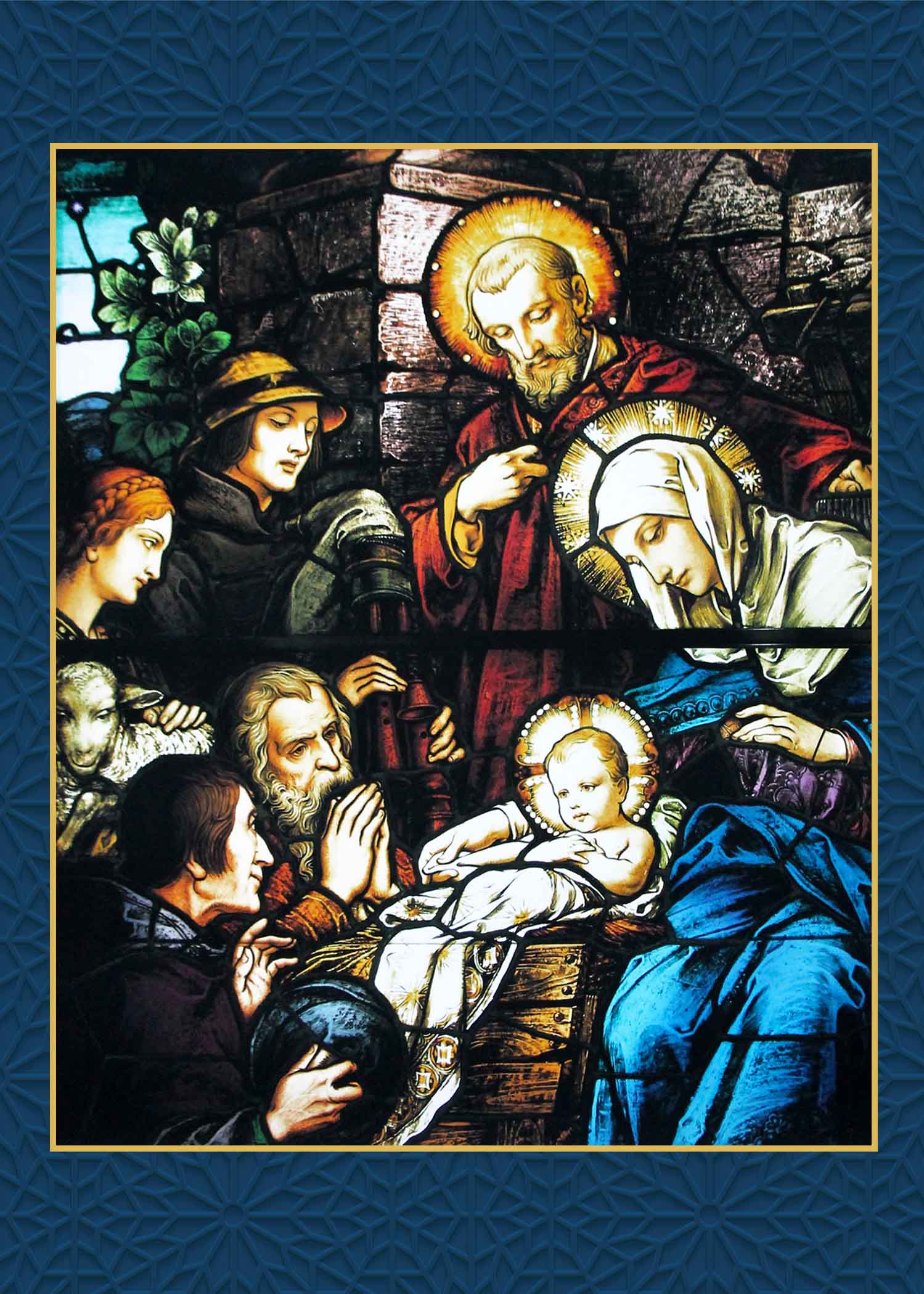 This year we are pleased to add a new Christmas card to our collection: God Most High. Here the holy family is depicted in stunning stained glass, gathered together with shepherds in adoration of the Christ child. The inside text is Stanza 3 of Martin Luther’s Christmas hymn, “From Heaven Above to Earth I Come”:
This is the Christ, our God Most High,
Who hears your sad and bitter cry;
He will Himself your Savior be
From all your sins to set you free.
Luther wrote the text of this hymn in 1534 as a sort of pageant or Christmas devotion for his own family. In fact, this particular stanza is addressed to the shepherds as part of “an extended paraphrase of the words of the angel from Luke 2:11–12. Luther goes beyond a simple retelling of the story to emphasize the great joy that comes from knowing that Jesus came ‘from all your sins to set you free,'” as Pr. W.H. Otto observes in a Lutheran Witness article from 2009. His entire article is worth reading to understand the hymn’s structure and how its writing was influenced by the 14th-century medieval folk tradition of the garland song.
Now Available: The Conduct of the Service
 We are pleased to announce that The Conduct of the Service, an invaluable resource for conducting the liturgy of the Church, is back in print. This book was first published by Redeemer Press in 2003, then reformatted and updated with pictures and diagrams in 2006. In 2012, Emmanuel Press assumed the management and distribution of the remaining copies, and we now offer this new printing with the same cover and content as the 2006 edition. This excerpt from the Preface written by Pr. David Petersen and Pr. Michael Frese explains its origin:
“Most of Piepkorn’s students had little experience with the ceremony, reverence, and decor that flowed from him so naturally. They recognized in his liturgical actions something of the Church that they wanted to imitate. Fortunately for us they continued to press him, until finally he relented and produced The Conduct of the Service, revised in 1965. It was printed by the Concordia Seminary print shop in St. Louis and sold in the seminary bookstore. He wrote it for his students, at their insistence. He never promoted it. And thus, it never enjoyed widespread dissemination and was quickly lost to the Church. Over the years it has been much sought after and much photocopied, but the copies that still exist are mostly torn and dog-eared.
“When he finally acquiesced to their demands, his training and preference for
systematics showed itself. He came at the description of ceremonies in a unique and
systematic way. He went after the rules. The rules he used are the rubrics prescribed in The Lutheran Hymnal of 1941 and in the companion volume for that hymnal, The Lutheran Liturgy. We have reproduced the latter in an appendix for easy reference. Incidentally, those rubrics have never been replaced by the LCMS. Unless they are explicitly contradicted, replaced, or restated in new Rites provided by the Commission on Worship, they are STILL the guide for the conduct of the Services in our churches. Where they have been updated and revised, Piepkorn’s descriptions and explanations tend to make even more sense. Thus, this is the best work up to our day on the practical execution of liturgy in the LCMS…
“It is our prayer that these words would again serve the Church and help unclutter Her Services from things that hinder and distract God’s people from His gifts.”
Read the full prefaces and take a look at the Table of Contents here.
Weedon endorses Liturgical Forms
 “If Matthew Carver’s translation of Friedrich Lochner’s The Chief Divine Service left you hungering and thirsting for more goodies in English from that finest liturgiologist of the early Missouri Synod, the volume you hold in your hands now will certainly satisfy that hunger and thirst.
“Lochner spreads a veritable feast before you for nearly every occasion where the pastor is expected to serve up the Word. Of course, the Mass is central (and he offers some more thoughts on that too!), but it does not exist in isolation. Put together at the request of his fellow pastors, Lochner again ransacks the Church Orders to present an Agenda that draws upon the vast wealth of our Church’s liturgical tradition for occasional services. Here you will discover ceremonies ranging from consecration of cornerstones and organs and churches, to ordinations and installations; from the children’s Christmas Service (delightedly catechetical!) to an order for Good Friday; from Baptism and Marriage to excommunication and private confession at Vespers. The list goes on and on! And with it all he includes a fine collection of prayers and collects.
“Liturgical Forms is truly the 19th century’s Pastoral Care Companion. Yet again, we find ourselves deeply in Matthew Carver’s debt as he continues to bring into English important works that give us vital insights into the lex orandi of the Lutheran Church.”
William Weedon, Assistant Pastor
St. Paul Lutheran Church, Hamel IL
Catechist on LPR Podcast: The Word of the Lord Endures Forever
A Daily, Verse-by-Verse Bible Study with the Church, Past and Present www.thewordendures.org
Now Available: Liturgical Forms by Friedrich Lochner
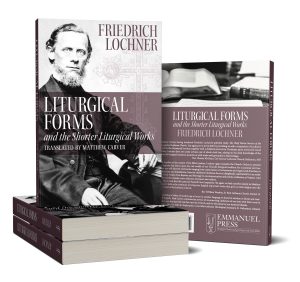
Liturgical Forms represents the latest stage in bringing Friedrich Lochner’s works into English, which was begun by Matthew Carver’s translation of The Chief Divine Service (2020). It shows the other facets of the liturgical life of the early Missouri Synod and particularly the interest in and desire for suitable and historically justifiable rites drawn from old, orthodox Lutheran sources.
It is comprised of two parts: first, the Liturgical Forms, a work originally published in 1895 as a compilation material (rites, prayers, etc.) from Lochner’s liturgical journal; second, shorter liturgical works that were published separately, including an order of service for Good Friday, an order for a children’s Christmas program, and a pamphlet called Feasts and Usages, a sort of explanation of the differences between Lutheran and Roman Catholic liturgical practices. Find the Table of Contents here.
This is an excellent resource for those interested in liturgy and the history of the Missouri Synod and of Lutheranism in America, providing the reader with ample reason to appreciate and thank God for Lochner’s faithful work and Carver’s superb translation.
“Matthew Carver, having translated Friedrich Lochner’s splendid study, “The Chief Divine Service of the Evangelical Lutheran Church,” has again put us in his debt by providing us with a translation of Lochner’s work on the Occasional Services, together with a children’s service for Christmas and a service for Good Friday. Lochner does not create services out of whole cloth but, relying on his deep knowledge of the Church’s liturgical treasures, presents us with works well grounded in that heritage.”
Pr. Charles McClean – Our Savior Lutheran Church, Baltimore, MD
______
Friedrich Johann Carl Lochner (1822–1902), born in Nuremberg, came under the influence of Wilhelm Löhe and moved to America, where he served as a Lutheran pastor and an instructor focusing on liturgics. During his time here, co-founded a teacher’s school in Milwaukee, WI, and was a professor at the seminary in Springfield, IL. Meanwhile, he edited and published a liturgical monthly, Liturgische Monatsschrift (1884–1886) to supply pastors with liturgical forms, prayers, and information lacking in the available agendas. Besides liturgical works he also published the polemical Notwehrblatt, which opposed Grabau, two devotional works for Passiontide and Easter, and a series of Epistle sermons.
Matthew Carver, a freelance translator specializing in German and Latin, lives in Nashville, TN, with his wife Amanda, a graphic designer, and their two sons Edward and Alfred.
Available soon: The Conduct of the Service – Pre-order and save 10%
We are pleased to announce that The Conduct of the Service is currently in the process of being reprinted. We’ll have more information soon on an expected release date. In the meantime, pre-order now to save 10% and be among the first to receive a copy from the new print run.
Gathering together works from Dr. Arthur C. Piepkorn and Rev. Charles McClean, this book is an invaluable resource for conducting the liturgy of the Church as it serves to teach reverence and encourage uniformity and beauty in worship.
The following is an excerpt from the first section, entitled “Notes on Reverence”:
________
There is really only one basic rule of good form: “Be courteous!” And similarly there is really only one basic rule of altar decorum: “Be reverent!” Every other rule is simply a practical amplification of this basic charge.
To be reverent we must first of all be humble. We are ministers — ministers of Christ, serving Christ in the room and in the name of fellow-sinners. We minister not because of any virtue in ourselves. Our sufficiency is of God. We minister as temples of the Holy Ghost, as being bound in sacramental union to the Lord of the Church, as kings and priests living in mystic communion with the Most Holy Trinity, as those whom Christ has chosen that we might be with Him and that He might send us forth to preach (St. Mark 3, 13). We minister under the aspect of eternity and in the Presence of the Divine Majesty. Wherever we stand, we are on holy ground. In such a ministry there is no room for pride, only for all-pervading humility.
To be reverent we must be prepared. We must know what we are doing, and why we are doing it. The physical preparations, as far as may be, should be taken care of well in advance. There should be no last-minute running to and fro, no hasty final preparation, no distressed paging about. A meditation, brief if need be, but as long as the time permits, ought never to be overlooked; spiritual preparation is more essential to reverence than the proper ordering of the physical adjuncts.
To be reverent we must be calm. The unforeseen, the accidental, the disturbing must not be permitted to distract us. We are God’s ambassadors and God’s servants. We are speaking for and to God. Our entire lives ought to be, and our public ministry must be en Christo – in Christ! So must the calm peace of the changeless Christ in our souls be reflected in our outward demeanor.
-Dr. Arthur C. Piepkorn, p. iii