
Now Available: Easter-Book by Friedrich Lochner
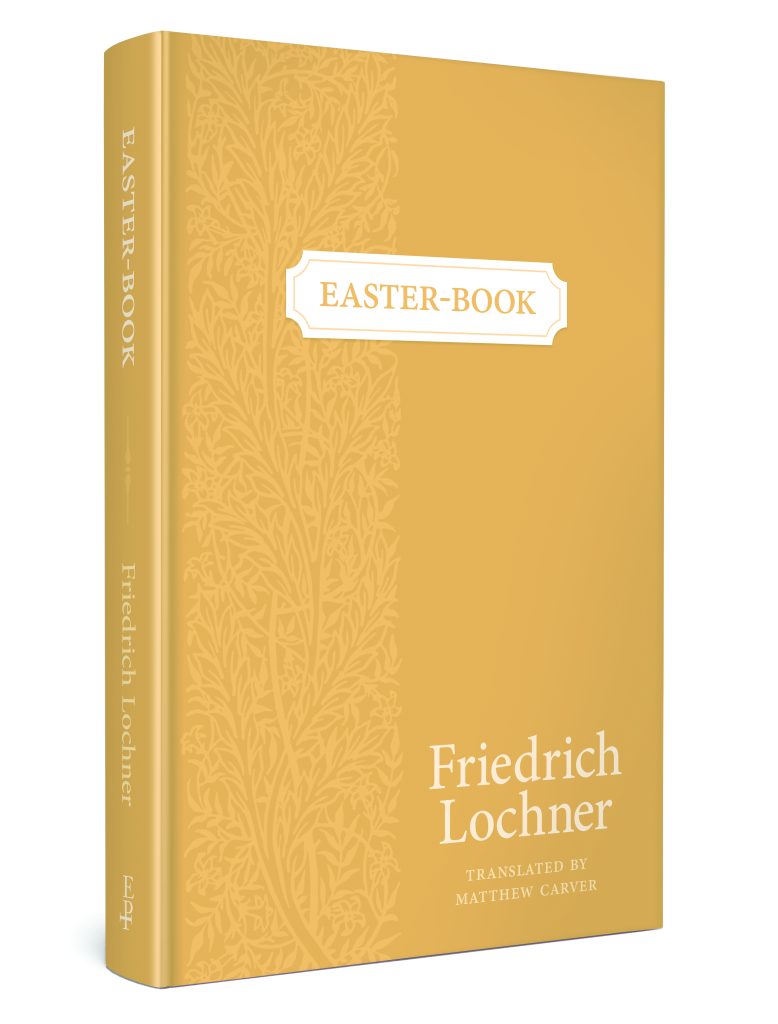
After publishing Passion-Book in 2025, we are pleased to now offer its companion: Easter-Book by Friedrich Lochner, translated by Matthew Carver.
This book provides 40 devotional readings for the 40 joyful days from Easter Day to the Ascension which contemplate our resurrected Lord’s appearances to His disciples before His ascension. Available for the first time in English, Easter-Book is compiled from the Gospels and Acts, combined with corresponding hymn stanzas and closing prayers. Find a description, detailed information, and excerpts here. (Note the special offer to buy both books together for 10% off.)
_________
An endorsement from Pr. Stephen Preus of Village Lutheran Church in Ladue, MO:
“Pastor Friedrich Lochner’s Easter-Book is an edifying forty-day devotional that focuses especially on the bodily resurrection of our Lord and its overflowing benefits for every Christian.
“A worthy companion to his Passion-Book, Lochner uses the biblical accounts of Christ’s resurrection to instruct Christians. Applying the lessons learned by saints like Mary Magdalene, Peter, and John, Lochner builds up our faith to see why our Lord’s resurrection is so vital for us each day. The meditations also help dispel false ideas of the resurrection, convict us of our misguided reason and human wisdom, encourage us in the new life we have in Christ, and, most of all, shower upon us the comfort of our Savior’s love and the bountiful blessings that arise from His vicarious victory over Satan, sin, and the grave.
“As in his Passion-Book, Lochner draws from Lutheran orthodoxy throughout, providing meditations, hymns, and prayers that bolster our common confession of the faith in our Lord’s resurrection. A thank you to Matthew Carver for his translation, which now supplies the Church today with easily digestible daily devotionals to help us celebrate in our homes and congregations the death of death and the Life in Christ that never ends.”
Now Available: The Great Works of God: Numbers
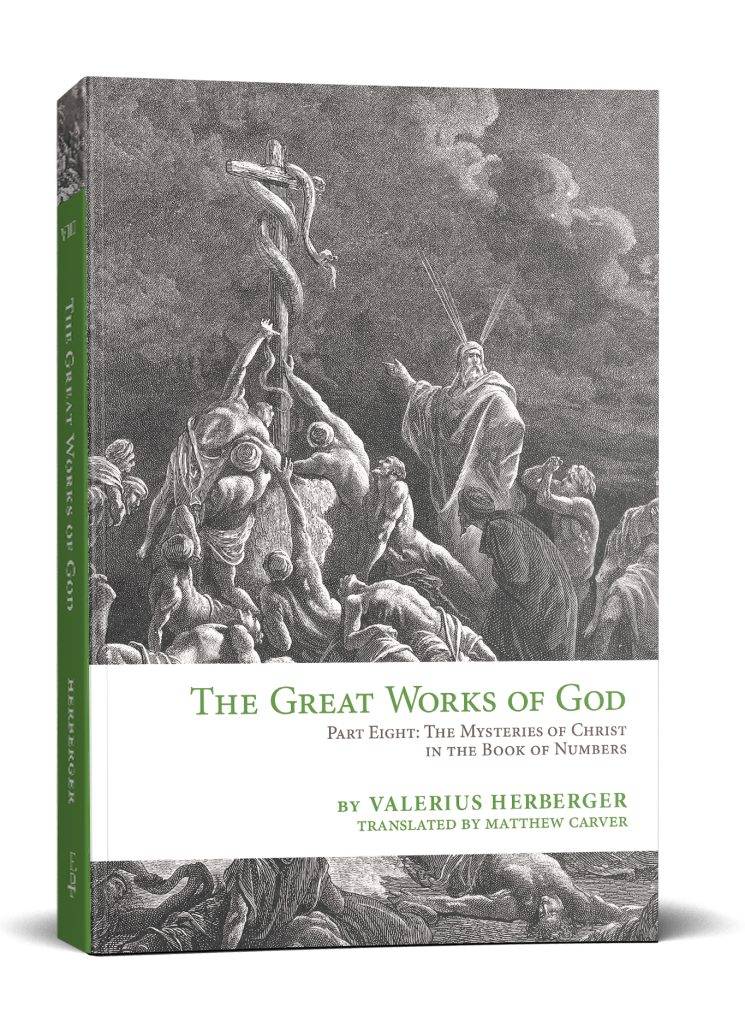 “The eighth volume of Valerius Herberger’s The Great Works of God, expounding the Book of Numbers, offers a richly devotional reading of Scripture that is at once profound and remarkably accessible. Moving meditation by meditation, Herberger unfolds the Book of Numbers as a sustained witness to Christ, presenting each passage in vivid, pastoral prose that invites rather than intimidates the reader. His style—warm, direct, and highly aware of history and literature—makes even dense theological reflection approachable for lay Christians, guiding them into a deeper love for Holy Scripture without requiring technical expertise.
“In an age often divided between academic analysis and spiritual reading, Herberger demonstrates that careful interpretation and heartfelt piety belong together. This edition makes a significant early modern voice available to the benefit of pastors preparing sermons, fathers leading home devotions, instructors engaging in classroom lectures, and any Christian who seeks to find Christ in the Book of Numbers.”
Rev. Jacob H. Benson — Assistant Professor of Humanities, Luther Classical College
_________
*Special thanks to the M.Div. class of 2026 of Concordia Theological Seminary, Fort Wayne, for commissioning the translation of The Great Works of God: The Mysteries of Christ in the Book of Numbers as their class gift.
Anointed with Ashes
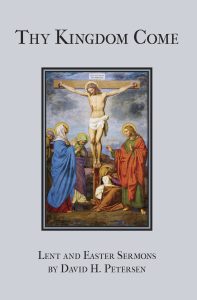 An excerpt from Thy Kingdom Come: Lent and Easter Sermons by David H. Petersen
“Your ashes are smeared today. There is no beauty in them. The world cannot see anything in them but an ugly smudge of dirt and death. But for those with the eyes of faith, they are in the form of a cross, that most lovely and dear of all symbols, that emblem of our hope.
“We set our faces toward Jerusalem today. We turn our backs on sin. We look through the gallows on Golgotha and see the glory of the cross enlightening the empty tomb. He has been lifted up from the earth to draw us to Him, to drain the Law’s accusing power, to empty hell’s claim, to crush the devil’s head, to bestow peace upon the meek.
“You are a holy people, anointed with ashes. You belong to the Lord. His mark and name are upon you. This is what it is to be sanctified, to be holy. You are forgiven, to be sure, but there is more than that. You are not only forgiven, or just made even with God, as though you never did anything wrong, and that is that. There is more. For not only has your debt been wiped out, but there is a credit to your account. You aren’t just even; you are holy. You belong to Him. You have the superabundance of His good works counting as your own, and the earth, indeed all of the universe, is your inheritance.
“So remember that you are dust and that you will return to dust. But remember also that God is a man, dust like you, joined to your temptations and sorrow, welded to your death, who was roasted to death in the Father’s wrath, reduced to ashes, and laid to rest in God’s good acre as a ransom, a whole burnt offering. That man is risen again from the dead and has come forth from the earth like a plant in the spring, that He would be your God. Turn your back on sin. Turn toward the Lord and His mercy. For here is peace and joy. Here is hope and faith.”
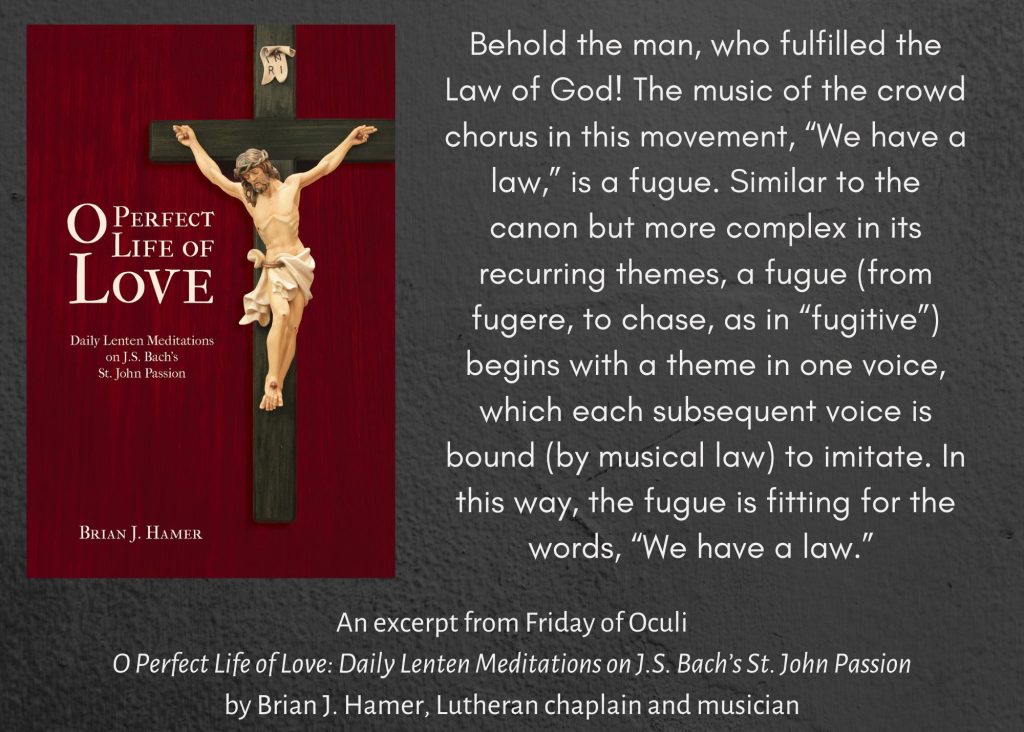
O Perfect Life of Love: Daily Lenten Meditations on J.S. Bach’s St. John Passion
Thy Kingdom Come: An Excerpt from Septuagesima
 “The main point of the parable is that entrance into the kingdom comes by grace. The workers are rewarded for work they did not perform. This is hardly a surprise to us; in fact, we practically expect it.
“G.K. Chesterton once said, ‘Do not be proud of the fact that your grandmother was shocked at something which you are accustomed to seeing or hearing without being shocked…It may be that your grandmother was an extremely lively and vital animal and that you are a paralytic.’
“Chesterton has in mind immoral things. He means, ‘Don’t think you are more sophisticated than your grandmother because you watch television shows full of vulgarities and aren’t bothered by them. It could be that she was highly intelligent and sensitive and you have been paralyzed by evil so much that you don’t even notice it.’
“The same sort of numbness applies to the Gospel as well. I fear that it is even worse. We’re not just numb, but we’ve crossed over the line drawn by Bonhoeffer into ‘cheap grace.’ I fear we’re now guilty of thinking grace is worse than cheap; it is a right, an entitlement, as though God owed us salvation. Repent.”
–These are the first 4 paragraphs from the sermon for Septuagesima, based on Matthew 20:1-16. Find Thy Kingdom Come here.
Passion-Book: Judas Makes a Traitorous Pact
But then entered Satan into Judas, named Iscariot, being of the number of the Twelve. And he went his way and communed with the chief priests and captains, that he might betray Him, and said, What will ye give me? I will deliver Him unto you. When they heard it, they were glad. And they covenanted with him for thirty pieces of silver, and he promised. And from that time he sought opportunity to betray Him without rumor.
Matthew 26:13–16; Mark 14:10–11; Luke 22:3–6
O Judas, is this the reward for the faithfulness and benefits that Christ showed thee? For a handful of coins thou sellest the One who is to be prized higher than heaven and earth? Woe to thee! This deed shall be to thy hurt in body and soul!
Here from this terrible deed of Judas’ let every man learn, first, how the devil is such a powerful enemy, who stirs up and drives men to sin, and that “he that committeth sin is of the devil” (1 John 3:8). Therefore we are to resist him, steadfast in the faith. Second, that covetousness is a root of all evil. Behold, Judas lets himself be so taken in by the insatiable devil of covetousness that he betrays his own Lord and Master, who is the Son of God and whose glory he has seen with the other disciples, for thirty pieces of silver. For because the damnable love of money brings great harm, and at the same time ill-gotten goods are kept in a purse full of holes, therefore let every Christian keep himself from this vice, and pray daily with David: O Lord, “incline my heart unto Thy testimonies, and not to covetousness” (Psalm 119:36). Third, let it be learned that many people in the world, out of sheer vainglory and greed for money, hatred and envy, and other in ordinate affects, bring themselves and others into all manner of mischief, sorrow, and misery, and lose their life and limb, yea, even their salvation. For because Judas saw that by the anointing of Christ here, a goodly sum had slipped through his fingers, and that he could not attain to worldly honor and great riches with Christ and His Gospel, he sought every opportunity to be rid of Christ, to take revenge on Him, and to obtain great honor, money, and goods with the chief rulers of Jerusalem. Therefore he offered to betray Christ.
This was a bitter suffering for the Lord Christ. But He left us a pattern, that we should walk in His steps and imitate Him and suffer with patience when we have done all good to others and afterward are betrayed and sold and brought into sorrow and misery by them. Chrysostom, the doctor of the church, the veritable “Goldenmouth,” had with him a deacon by the name of Severianus, a hypocritical babbler, whom he sometimes caused to preach for him and did him every good at the court of Emperor Arcadius. But afterward, the Empress Eudoxia made so much of this abominable hypocrite that he despised his preceptor and finally drove him into exile and misery, in which the holy man died in the year after the death of Arcadius.
But see that the Lord Christ is the true Joseph, who is sold by his own brothers, as Zechariah prophesied (Zech. 11:12–13). He is sold and betrayed for our sake. It cost a great deal to redeem our souls, for God’s only Son Himself is the Ransom, yet He is appraised at only thirty pieces of silver. But it was so resolved that He who was counted as nothing before the world should count a great deal before His heavenly Father, and His death should be a plentiful payment for the sins of the children of men.
_______
An excerpt from Passion-Book by Friedrich Lochner, edited and translated by Matthew Carver, Devotion 5
Comfort in Sorrow

The Word Remains is a collection of excerpts comes from Wilhelm Löhe’s extensive writing on mission, pastoral theology, history, and liturgy. Originally published in German in 2008, this English translation of a delightful book that gathers his profound wisdom into one small volume, offering devotional reading on the church year, the Word of God, and matters related to the Christian life: faith, prayer, fellowship, worship, creation, and hope.
The Advent Wreath: An Excerpt
 “The lighting of an Advent wreath during the Advent season is a Christian ceremony which has come down to us from about the time of Martin Luther. As before the birth of Christ the light of prophecy concerning His advent and His redemptive work became brighter and brighter, so the nearer we come in the church year to the feast of His nativity, the greater the amount of light from the Advent wreath. This ceremony is helpful for recalling, discussing, and teaching the significance of Advent.”
-An excerpt from Ceremony and Celebration, in which Rev. Paul H.D. Lang describes the theological significance and historic, confessional Lutheran position on liturgy, ritual, and ceremony.
Liber Hymnorum is back in stock
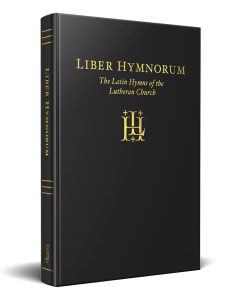 Liber Hymnorum is back in stock! This is a collection of hymns taken exclusively from Lutheran hymnals and chant-books of the Reformation and post-Reformation era. It is two hymnals in one, the first half being English, the second Latin, exactly mirroring the first half in contents and numbering.
Find much more information here, including reviews and a sample of the interior.
Not just for the altar guild…
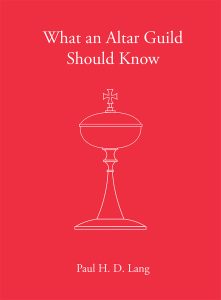 “The service which the altar guild can render is valuable as an aid to extol the beauty and greatness of God and to awaken the response of His people in all forms of beauty, care, and reverence. Beauty in the church is not a matter of indifference….Why do we want to make the house of God and our worship of God as reverent and beautiful as possible? Such a desire is of God and for God. He is present in our churches. Through His Word and sacraments, Christ comes to us as we are gathered together in His name.” (p. 11)
In What an Altar Guild Should Know, Paul H.D. Lang gives detailed information about church services and rubrics, liturgical terms, everything related to the altar, sacred vessels and linens, paraments, and other topics related to liturgical worship.
However, this is not just a How To manual for altar guild members and their pastors. Lang offers keen theological insight into why reverence and beauty and the externals of worship matter. Anyone interested in liturgical worship would benefit from reading this book (especially in conjunction with Ceremony and Celebration) In addition, we have switched to a Wire O binding so that it can now lay flat.
Preparing a setting for the Gospel: “By making God’s house and the services of the church more beautiful, we provide the Gospel a setting in which it is more attractive to people and puts them in a more receptive frame of mind for worship….Of course, God’s Word and sacraments are not dependent on human embellishment for effectiveness. They are in themselves ‘the power of God unto salvation to everyone that believeth’ (Rom. 1:16). It is only fitting, however, that we should present them in surroundings that are as attractive as we can make them.” (p. 11-12)
Externals not essential, but important: “God has not given Christians of the New Testament era specific laws governing the outward forms of worship. Christianity is not essentially a matter of externals but of faith and life….Where the Word of God is rightly taught and the sacraments are rightly administered, there is the Christian church….Nonetheless, externals are invariably associated with Christian worship. Therefore they are important. Christian doctrine, faith, and life are never merely theoretical, barren, or lifeless. They express themselves in outward acts.” (p. 12-13)